
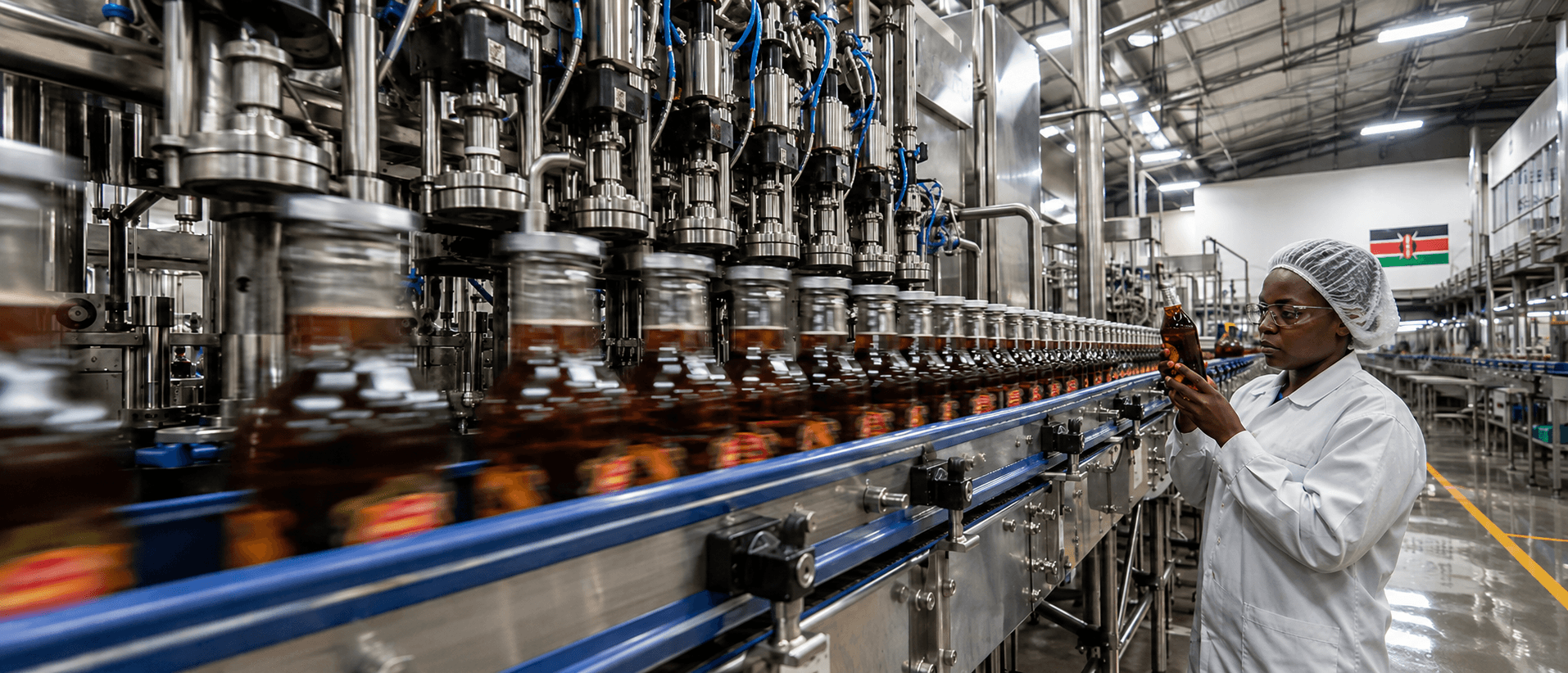
Equipment for food and beverage plants.
Dairy, beverage, edible oils, brewing, bakery. Single supplier across stainless processing tanks, jacketed vessels, grain silos, structural fabrication, and the full instrument stack. Sanitary tri-clamp, food-grade finishes, regulatory-compliant sourcing.
Food and beverage buyers invest in equipment to support growth.
F&B operators typically invest in equipment to support expansion: a new line, a new SKU, a new facility, or a new export market.
That changes what matters in the spec. Material grade for the SKU, sanitary fittings for the audit, CIP coverage for the operator, and lead time for the launch date. We design around all four.
We work in 304 stainless as the default, 316L wherever chlorides or organic acids show up, and epoxy-lined for the caustic and acid sides of CIP. Every tank is pre-tapped for the instruments that hit the spec sheet.
Five vertical sub-applications, all in scope.
Dairy
Equipment fit: SS 304 + 316L (whey), epoxy-lined for caustic, flow + level + temp instruments
Milk silos, jacketed processing tanks, CIP loops, instrumentation for capacity-expansion projects and new product lines.
Beverage
Equipment fit: SS 304 throughout, sanitary fittings, flow + level + pH
Bright tanks, syrup tanks, blending tanks, water polishing. Sanitary tri-clamp throughout, instrumentation pre-tapped.
Edible Oils
Equipment fit: SS 304 main, 316L for FFA acid wash, temperature + pressure
Refining tanks, deodorising vessels, intermediate storage with jacketed heating loops.
Brewing
Equipment fit: SS 304/316L, grain silos, flow + level + temp + pressure
Mash tuns, lauter tuns, fermenters, bright tanks, malt silos. Sized for craft (50 to 500 HL) and industrial (5,000 HL+) breweries.
Bakery & Grain
Equipment fit: Galvanised grain silos, level instrumentation, aeration
Flour silos, mill intake silos, ingredient-handling silos for high-throughput bakery operations.
Food and beverage operators invest in infrastructure to support growth in demand, new product lines, and new markets.
Sub-applications
5Dairy, beverage, edible oils, brewing, bakery & grain — all in scope.
Shipped, worst case
8 wkF&B briefs on a deadline, shipped in 4 to 8 weeks.
Audit window
12 moA plant audit triggers a replacement program inside 12 months.
Four reasons F&B operators call us first.
- 01
Capacity expansion
Existing line at ceiling, new SKUs in the pipeline, demand outstripping current vessel capacity. The most common F&B buying trigger we see.
- 02
New product line
Fresh SKU needs its own vessel train. Spec is usually material-driven (304 vs 316L) plus a CIP loop that ties into the existing utility headers.
- 03
Plant audit
Regulatory or third-party audit identifies aging vessels or insufficient sanitary design. Triggers a replacement program inside 12 months.
- 04
Food-safety failure
Recall or quality event traces back to vessel hygiene. Urgent spec for sanitary tri-clamp fittings, surface-finish upgrades, CIP coverage gaps.
The buying frame · Food & Beverage
“F&B equipment investment is typically driven by growth, not just compliance.”