
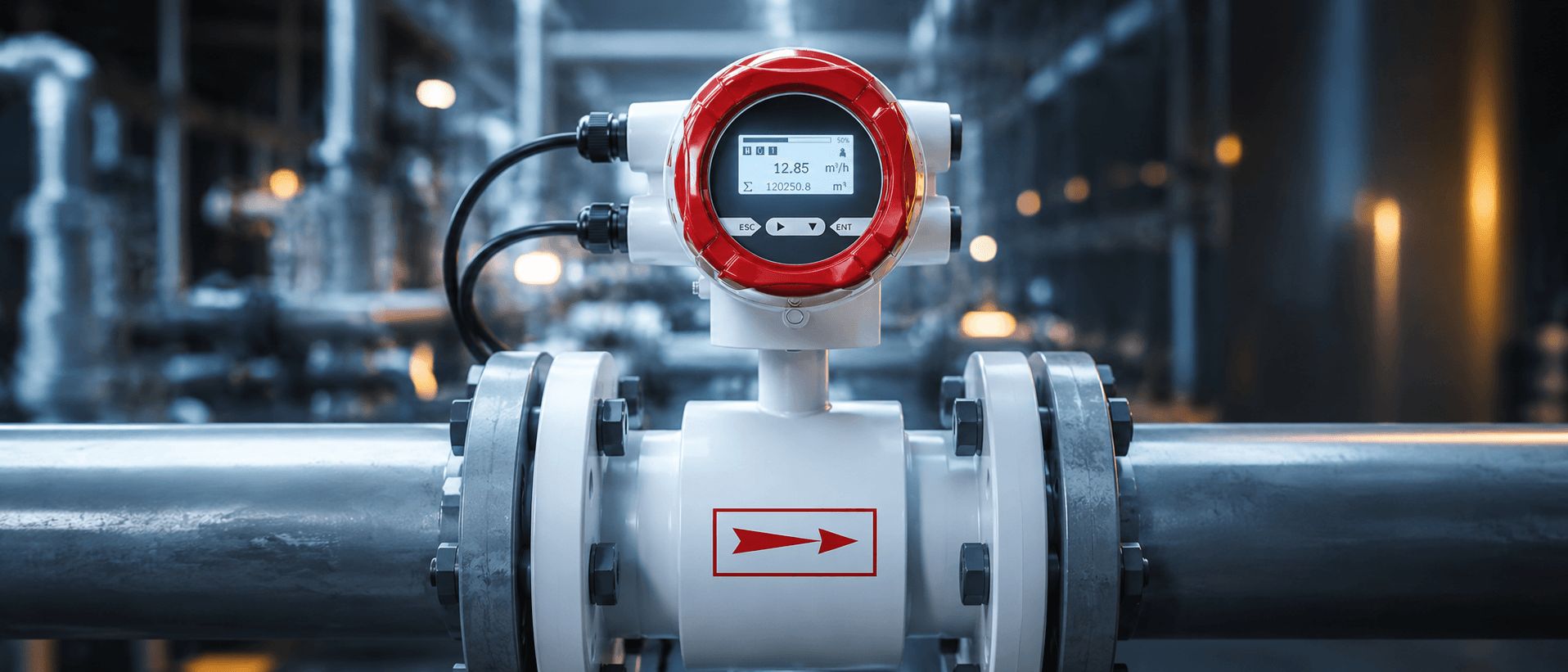
Six flow technologies, one for every duty.
We size flow meters to the medium being measured. Electromagnetic for conductive process water and food-grade duty, vortex for steam and gases, ultrasonic for non-invasive retrofit, Coriolis for mass-flow accuracy, thermal mass for gas audits, turbine for custody transfer.
Pick by the medium first, the technology second.
Picking a flow meter is mostly about picking the right technology for the medium and the duty. The standard answer is electromagnetic because most industrial duties involve conductive liquids and the technology is accurate, has no moving parts, and is forgiving on installation.
The exceptions matter though. Steam needs vortex. Compressed-gas auditing wants thermal mass. Custody- transfer pulse counts come from turbine. Mass-flow accuracy regardless of density comes from Coriolis. Non-invasive retrofit comes from ultrasonic. We size the meter to the duty, not the other way round.
Six technologies, when to use each.
- 01
Electromagnetic
Conductive liquids: process water, ETP discharge, dairy CIP, beverage syrup
Most common workhorse; no moving parts, full-bore, food-grade variants available
- 02
Vortex
Steam, compressed air, gases, and clean liquids with no conductivity
Integral T+P compensation option for mass-flow on steam
- 03
Turbine
Clean low-viscosity liquids, custody-transfer fuel metering
Pulse output; high accuracy on stable flow profiles
- 04
Ultrasonic
Non-invasive metering on existing pipework, water utilities, irrigation
Clamp-on or wall-mount; portable variants for spot-checks
- 05
Coriolis mass
True mass flow regardless of fluid density; chemical batching, fuel transfer
Highest accuracy class; higher cost; tightest installation tolerances
- 06
Thermal mass
Gas mass flow; compressed-air audits, biogas metering, process gas
Direct mass-flow reading without P+T compensation
The shared spec floor.
The technology-specific spec is on the data sheet we send with the quote. The numbers below are common across everything we supply.
- Standard signal outputs
- 4 to 20 mA, pulse / frequency, Modbus RTU (RS485)
- Smart protocols
- HART on most electromagnetic and vortex models
- Process connection
- Wafer (DN15 to DN1000), flanged ANSI / DIN, sanitary tri-clamp
- Liner materials (mag)
- PTFE for chemical, hard rubber for water, food-grade rubber for F&B
- Electrode materials (mag)
- 316L, Hastelloy C, tantalum (acid duty)
- Temperature range
- Liquid duty to 150°C; steam vortex to 350°C
- Pressure rating
- PN16 to PN100 depending on connection class
- Hazardous-area certified
- ATEX zones 1 and 2 available on most types