
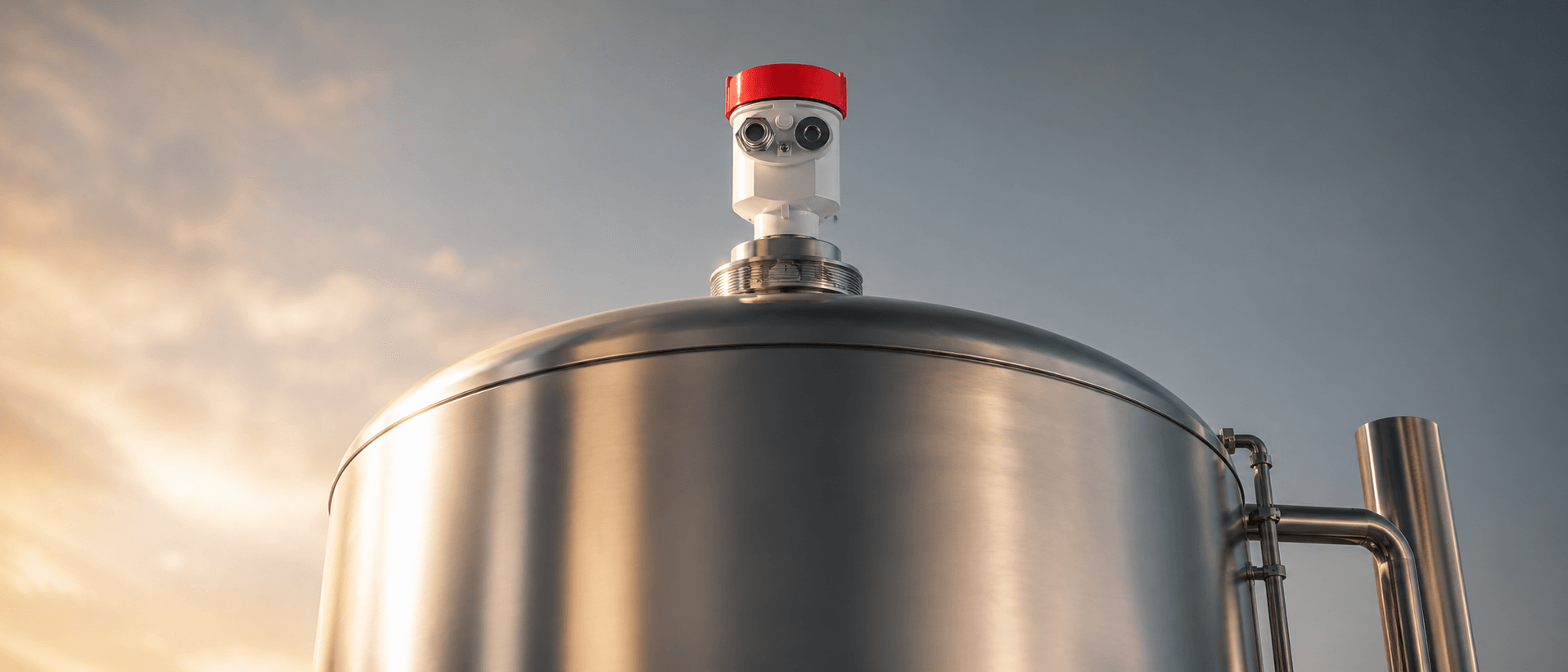
Six level technologies, from open sumps to pressurised vessels.
Pick by what you're measuring and the medium it sits in. Radar is the default for tanks. Ultrasonic for sumps. Hydrostatic for slurry. Guided-wave for foam, interface, or narrow vessels.
The right technology depends on the vessel as much as the medium.
A tank-level reading sounds like one problem. In practice it is at least four: clear-liquid in a large open-top tank, foamy liquid in a process vessel, slurry in an open sump, and pressurised condensate in a boiler. Each one wants a different sensor.
We size against the geometry as well as the medium. Vessel diameter, nozzle dimensions, agitator presence, vapour conditions, and required accuracy all narrow the technology choice. The recommendation comes with the quote.
Six technologies, when to use each.
- 01
Radar, 26 GHz
General-purpose tank level; clear liquids; long-range
Most common. Forgiving of foam, vapour, and temperature swings
- 02
Radar, 60 / 80 GHz
Narrow nozzles, small vessels, agitated liquids
Tighter beam angle, sharper near-field; premium price
- 03
Ultrasonic
Open channels, sumps, simple water tanks; non-contact
Affordable; affected by foam and temperature gradients
- 04
Hydrostatic submersible
Open wells, sumps, slurry pits; bottom-of-tank submersion
PTFE or PVDF body for chemical duty; high-temp variants available
- 05
Guided-wave radar
Interface measurement, foamy or steamy media, narrow vessels
Probe extends into the medium; immune to vapour interference
- 06
Differential pressure
Pressurised vessels, boilers; level inferred from DP cell
Use when radar/ultrasonic cannot reach (sealed pressure vessels)
The shared spec floor.
- Standard signal outputs
- 4 to 20 mA with HART, Modbus RTU (RS485)
- Measurement range
- 0.1 to 100 m depending on technology
- Accuracy
- ±3 mm (radar), ±2 mm (guided-wave), ±0.25% FS (hydrostatic)
- Process connection
- Flanged ANSI / DIN, thread, or sanitary tri-clamp
- Materials
- 316L, PTFE, PVDF, Hastelloy C for chemical duty
- Temperature range
- Process duty to 250°C, antenna to 80°C ambient
- Hazardous area
- ATEX zones 0, 1, 2 variants available on most types