
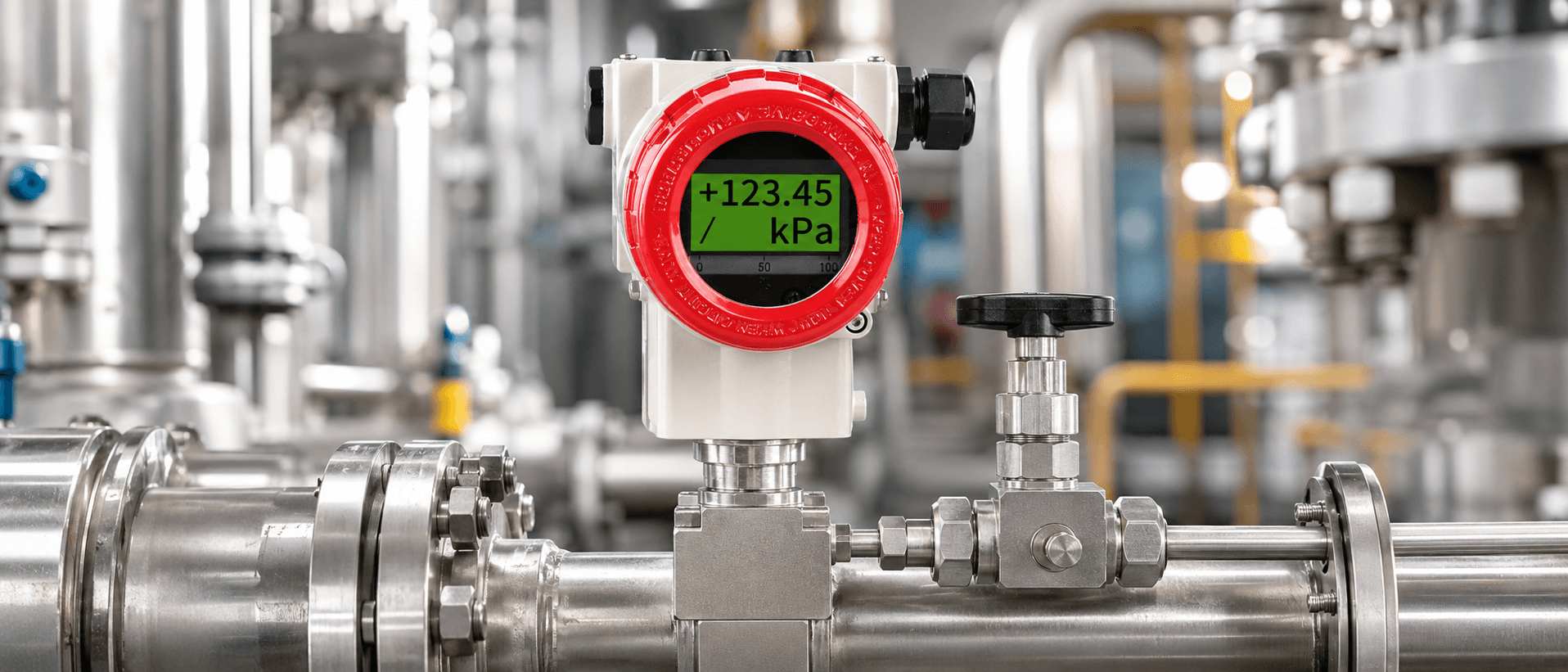
Four pressure modes, picked to the duty.
Gauge for process headers and pumps. Absolute for vacuum and altitude-sensitive duty. Differential for filters, flow, and sealed-tank level. Combined P + T for steam metering.
The mode you pick depends on what the reading is for.
Pressure is the easiest process variable to measure and the hardest to get right at scale. The technology is mature; the mistakes are usually in mode selection, wetted-parts compatibility, or temperature compensation.
We supply gauge, absolute, differential, and combined P + T transmitters with diaphragm seals where the medium needs isolation, and capillary cooling where the process temperature exceeds the transmitter limit.
Four modes.
- 01
Gauge pressure
Most common; pressure read relative to atmospheric
Used on pumps, process headers, hydraulic systems
- 02
Absolute pressure
Pressure read relative to vacuum; used when ambient is changing
Distillation columns, vacuum dryers, altitude-sensitive duty
- 03
Differential pressure
Pressure drop across an orifice, filter, or pump
Flow inference, filter-clog detection, level on sealed tanks
- 04
Combined P + T
Pressure and temperature in one tap; saves a nozzle
Steam metering compensation, custody-transfer applications
The shared spec floor.
- Range options
- Vacuum to 1000 bar depending on model
- Accuracy
- ±0.075% to ±0.25% of span, model-dependent
- Signal output
- 4 to 20 mA, HART standard; Profibus and Foundation Fieldbus available
- Process connection
- 1/2-inch NPT, G1/2, flanged, sanitary tri-clamp
- Wetted parts
- 316L SS standard; Hastelloy, tantalum, Monel for chemical duty
- Diaphragm seal
- Available for high-temperature or aggressive media duty
- Process temperature
- Up to 400°C with cooling element / capillary seal
- Hazardous area
- ATEX zones 0, 1, 2 variants