
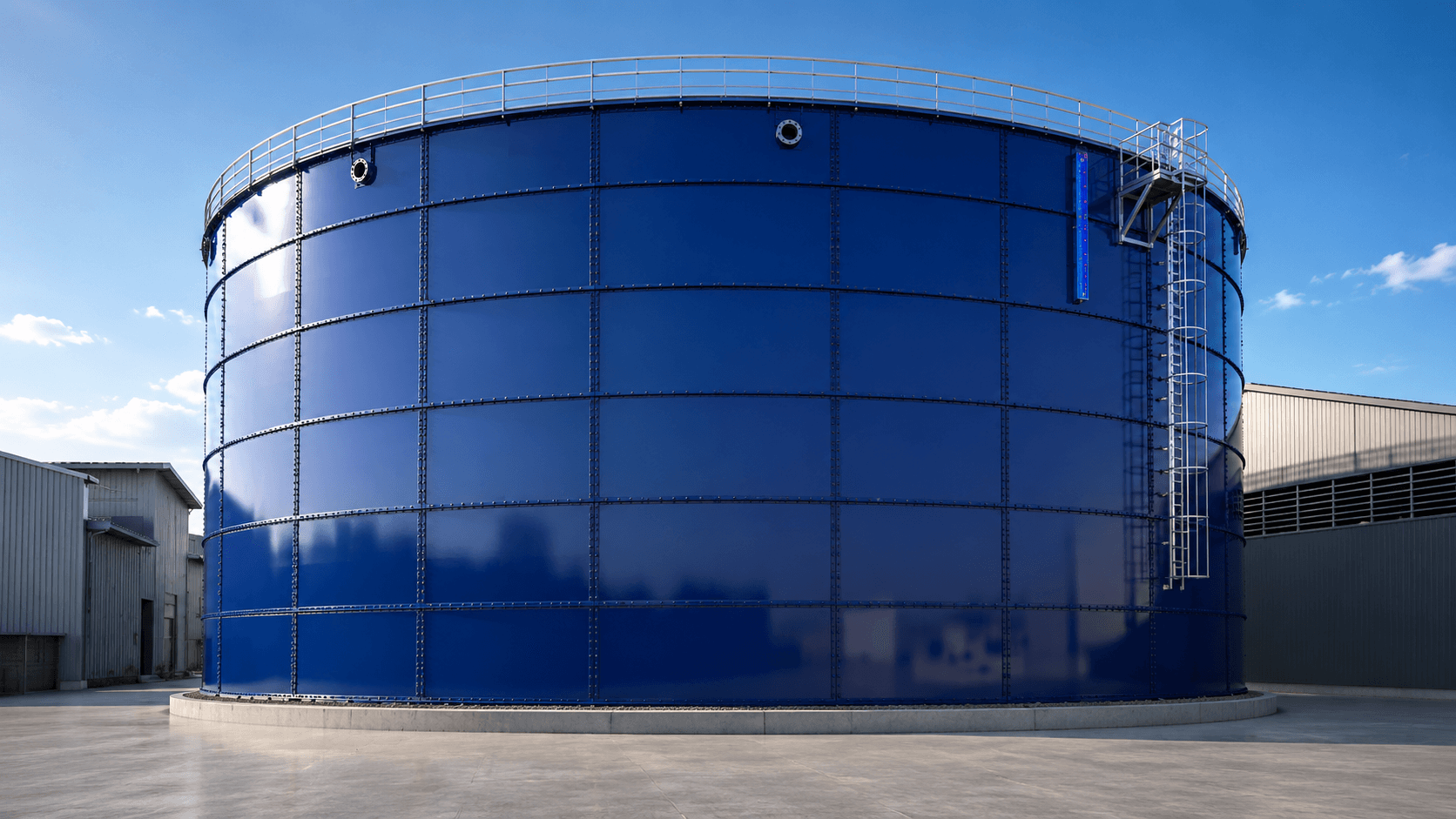
Bolted carbon steel tanks, lined with fusion-bonded epoxy.
The tank shown here is bolted and epoxy fusion-bonded, built for ETP chemical dosing and corrosive process water where stainless costs more than the duty needs and plain carbon steel will not survive the medium. Built in-house, lined to the chemistry, and cured before delivery.
The right tank for duty where stainless is unnecessary and plain carbon steel will not survive the medium.
A lot of process duty sits in the gap between food-grade hygiene and bulk water storage. Acid dosing, polymer preparation, treated effluent intermediate storage, caustic CIP loops. Stainless overspends on the duty; carbon steel pits or corrodes through inside two years.
Epoxy-lined tanks fill that gap. The shell is carbon steel S275 or S355 to handle the structural load. The interior is blast-cleaned to Sa 2.5 and coated with a two-component chemical-resistant epoxy, picked against the specific medium and concentration on the brief.
We supply with either an industrial-grade or food-grade lining where the duty allows it. The lining cure schedule runs inside the shop, so the tank arrives on-site ready to fill.
Blast-cleaned to Sa 2.5 · lined to the chemistry
Lining is picked to the medium.
The numbers below are the default. The right epoxy for your chemistry depends on the medium and its concentration. Tell us both, and we will quote the lining system that matches.
- Shell material
- Carbon steel S275 / S355
- Lining system
- Two-component chemical-resistant epoxy, food-grade or industrial
- Lining thickness
- 400 to 600µm dry film
- Capacity range
- 1 to 200m³
- Wall thickness
- 4 to 12mm
- Surface preparation
- Sa 2.5 blast cleaning before primer + topcoat
- Compatible media
- Dilute acids and alkalis, ETP dosing chemicals, treated effluent
- Not compatible with
- Strong oxidising acids, ketones, chlorinated solvents
- Standard fittings
- Bolted manway, drain, fill port, instrument flanges
- Lead time
- 5 to 8 weeks ex-works, including lining cure time
Blast-cleaned to Sa 2.5, lined to the chemistry, cured before delivery.
From 1 m³ dosing tanks to 200 m³ storage.
400 to 600 µm two-component epoxy, dry film.
4 to 12 mm carbon-steel shell, S275 or S355.
Where epoxy-lined steel does the job.
ETP chemical dosing
Alum, ferric chloride, lime, polymer dosing tanks for effluent treatment plants where stainless is overkill and carbon steel won't survive the medium.
Acid storage
Dilute sulphuric, hydrochloric, and phosphoric acid storage. Lining grade picked against the specific acid and concentration.
Caustic and alkali
Sodium hydroxide dosing, CIP caustic loops, treated alkaline effluent storage.
Treated water polishing
Intermediate storage between treatment stages where neutral or near-neutral pH is the operating point.
Lining selection · epoxy-lined steel
“The right epoxy for your chemistry depends on the medium and its concentration.”