
Inside the workshop: what TIG-welding a stainless tank actually looks like
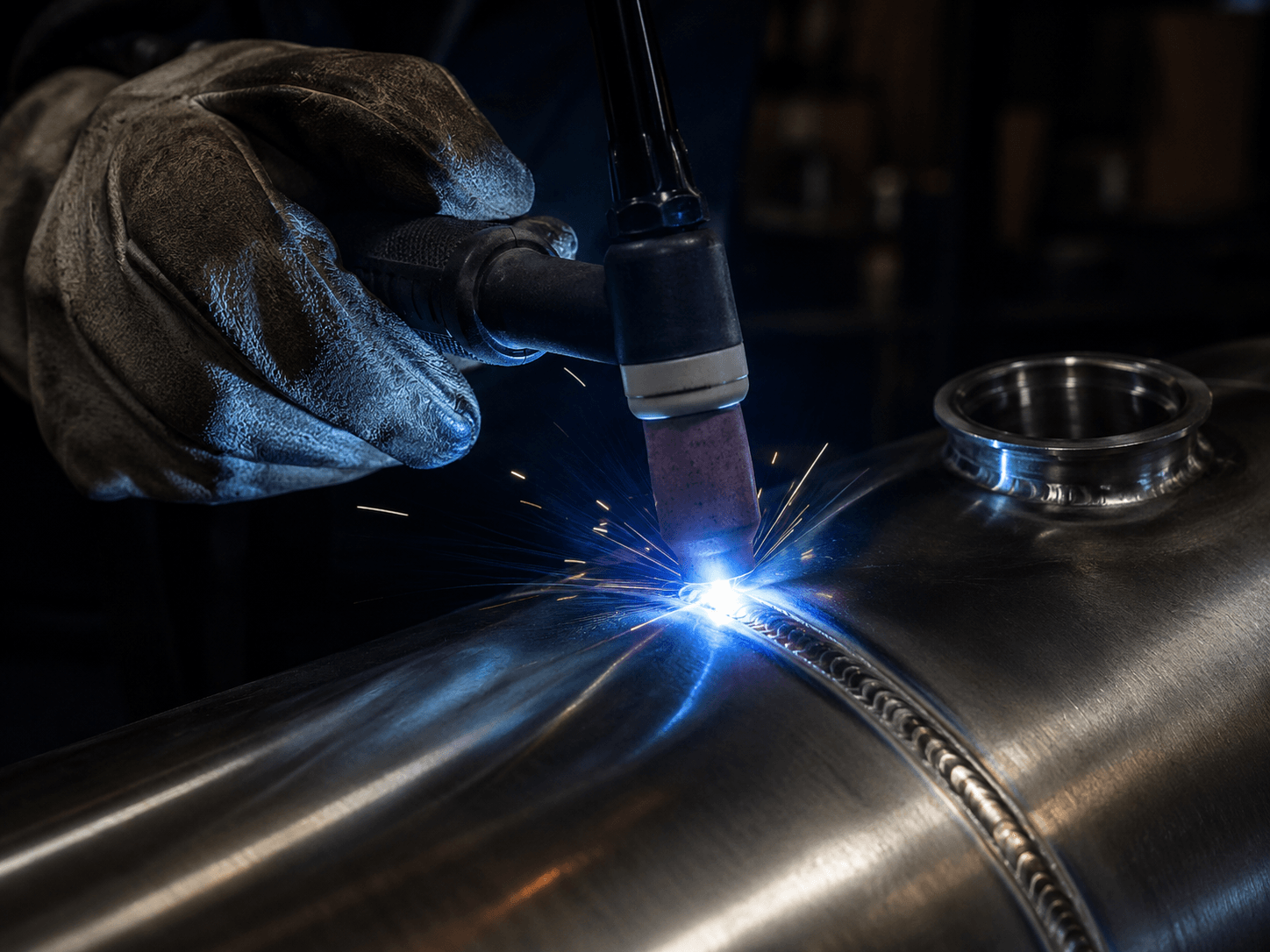
A stainless tank is what comes out of the welding bay. The welding bay is what we live in. Here is what actually happens in there, in the order it happens.
Edge prep
Before any weld goes down, the plate edges are bevelled and cleaned with a stainless-only wire brush. Carbon-steel contamination on a stainless weld zone causes corrosion years later, so the workshop separates carbon and stainless tooling completely. Stainless wire brushes are tagged with a yellow band; nothing else touches the stainless plate.
Argon backing
TIG welding stainless requires argon backing on the inside of the seam during welding. Without it, the back of the weld oxidises and you get the classic black "sugar" that can crack under cycling. The shop runs a fixed argon flow rate, measured at the regulator, on every seam.
The strike and the bead
The welder strikes the arc with a sharp tap-and-lift, then establishes a small molten pool. The torch moves in a consistent forward weave; filler wire is added on the leading edge of the pool. A good TIG bead on stainless looks like a row of overlapping coins, all the same size, with no discolouration on either side of the seam.
Dye penetrant
Every completed seam goes to the dye-penetrant test station. Penetrant is sprayed on, allowed to dwell, wiped off, and a developer is applied. Any crack or porosity in the seam pulls penetrant up and shows as a red mark against the white developer background. Pass criteria are written on the inspection sheet for each vessel.
The finishing pass
After dye penetrant, the seam is mechanically polished to the spec'd surface roughness (Ra). For food-grade vessels we target Ra ≤ 0.8 μm; for pharma-adjacent, Ra ≤ 0.4 μm. The polished surface is what your operator sees and what the inspector measures.
More on the workshop and the rest of the fabrication process is on the Local Manufacturing page.
Choosing a flow meter for a Kenyan industrial loop
Electromagnetic, vortex, ultrasonic, Coriolis, or thermal-mass? The medium, the pipe size, and the accuracy you actually need decide which one belongs on the line.
Read26 May 2026In-house structural fabrication: pipe racks, tank supports, walkways
Tanks and silos don't stand alone. The platforms, racks, and supports around them are usually the load-bearing schedule risk. Here is how we approach the rest of the steel.
Read26 May 2026How to specify a stainless tank for a Kenyan F&B plant
Material grade, surface finish, sanitary fittings, and the questions your fabricator wishes you'd ask first.
Read