
Choosing a flow meter for a Kenyan industrial loop
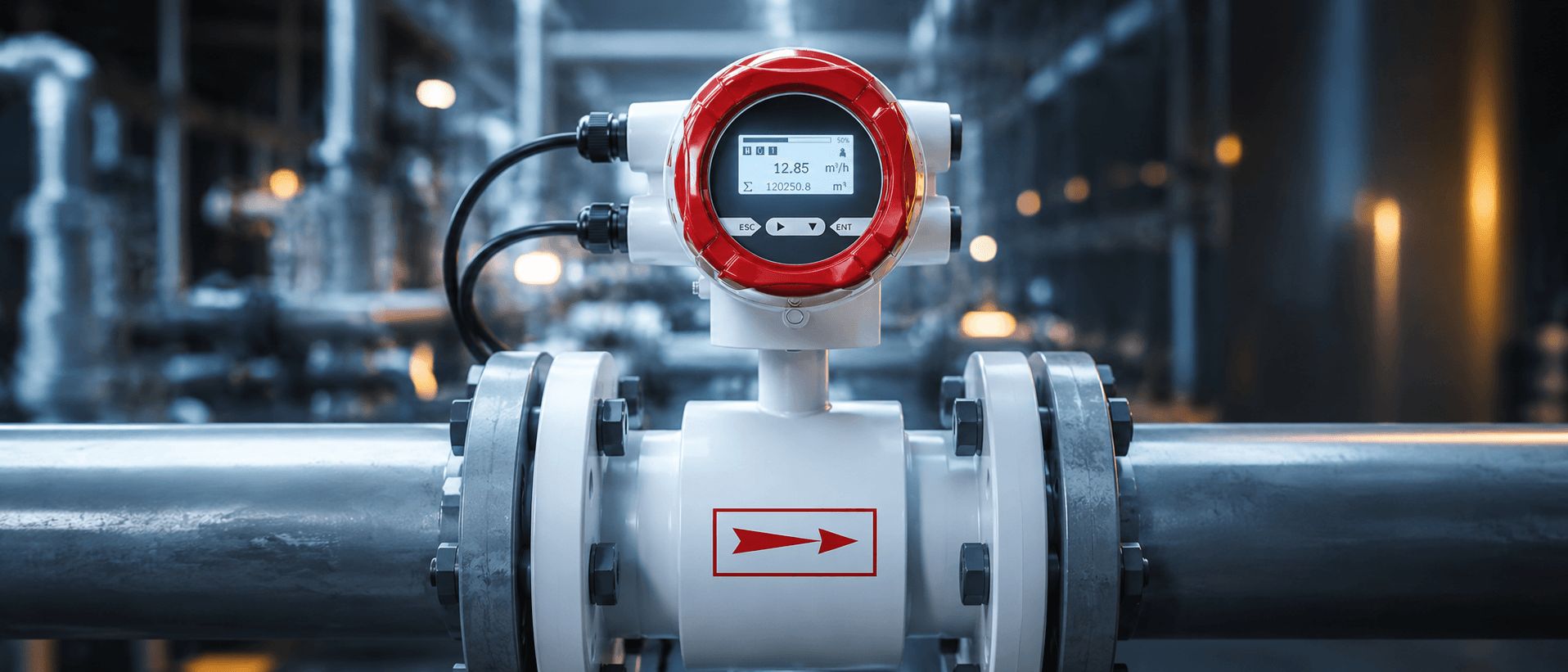
A flow meter looks like a one-line item on the BOM. It isn't. The wrong technology on the wrong medium produces readings that drift, that lie about totalised volume, or that simply stop working after the third cleaning cycle. Here is the conversation we have with most buyers, in the order we have it.
Electromagnetic: the default for conductive liquids
If the medium is water-like and electrically conductive (above roughly 5 µS/cm), electromagnetic is the right answer. No moving parts in the flow stream, no pressure drop, accuracy to ±0.2% of rate with proper sizing. Use it for raw water, ETP effluent, beverage base, dairy, and anything with even mild conductivity.
The two failure modes to know: empty-pipe readings (solved with empty-pipe detection on the transmitter) and ground-loop noise (solved with proper grounding rings on plastic pipe). Both are install-quality problems, not meter problems.
Vortex: steam, gas, and the hot liquids electromagnetic won't handle
Vortex meters work on the principle of vortex shedding behind a bluff body in the flow stream. They handle steam, dry gas, and superheated liquids where electromagnetic can't. Accuracy is typically ±1% of rate, which is good enough for utility metering but not for custody transfer.
The catch: a vortex meter has a minimum flow below which the shedding becomes unstable. Sized too generously, the meter spends much of its operating range below this threshold and reports zero. Size against the minimum flow, not the maximum.
Ultrasonic: clean liquids, no contact with the medium
Ultrasonic transit-time meters work for clean liquids in metal pipes and are non-invasive: the transducers clamp onto the outside of the pipe. Use them for utility water metering on large pipe sizes (above DN300, where the cost of an inline electromagnetic becomes punishing), and for retrofits where cutting into an existing line isn't practical.
Doppler ultrasonics, on the other hand, work for dirty liquids but with worse accuracy. They're a niche tool, not the default.
Coriolis: when you need mass, not volume
Coriolis meters measure mass flow directly by detecting the deflection of a vibrating tube under flow. Accuracy is ±0.1% of rate, the highest of any technology in the lineup. Use them for custody-transfer applications, edible-oil blending, chemical dosing where mass balance is the metric, and any process where density also matters.
They are also the most expensive technology by a wide margin and the most pressure-drop-heavy. Specify Coriolis only when mass-flow accuracy is actually the requirement.
Thermal mass: for low-flow gas
Thermal mass meters work by measuring the heat carried away from a heated element by the flowing gas. Use them for low- flow gas metering (compressed air consumption, nitrogen blanket flow, biogas) where the volumetric flow is too small for a vortex to resolve.
The questions that decide the right technology
Medium, conductivity if it's a liquid, pipe size, temperature, pressure, accuracy requirement, and turndown ratio. From those seven answers, the right technology falls out mechanically. The full instrument range is on the flow meter page; for a wider context on how flow integrates with the rest of your monitoring, see the remote monitoring page.
In-house structural fabrication: pipe racks, tank supports, walkways
Tanks and silos don't stand alone. The platforms, racks, and supports around them are usually the load-bearing schedule risk. Here is how we approach the rest of the steel.
Read26 May 2026How to specify a stainless tank for a Kenyan F&B plant
Material grade, surface finish, sanitary fittings, and the questions your fabricator wishes you'd ask first.
Read22 May 2026Reading the Kenyan discharge parameters table, for plants that need to pass
The 10 parameters that decide whether your effluent enters a public sewer or an environmental discharge route, what each one means, and what equipment hits each target.
Read