
In-house structural fabrication: pipe racks, tank supports, walkways
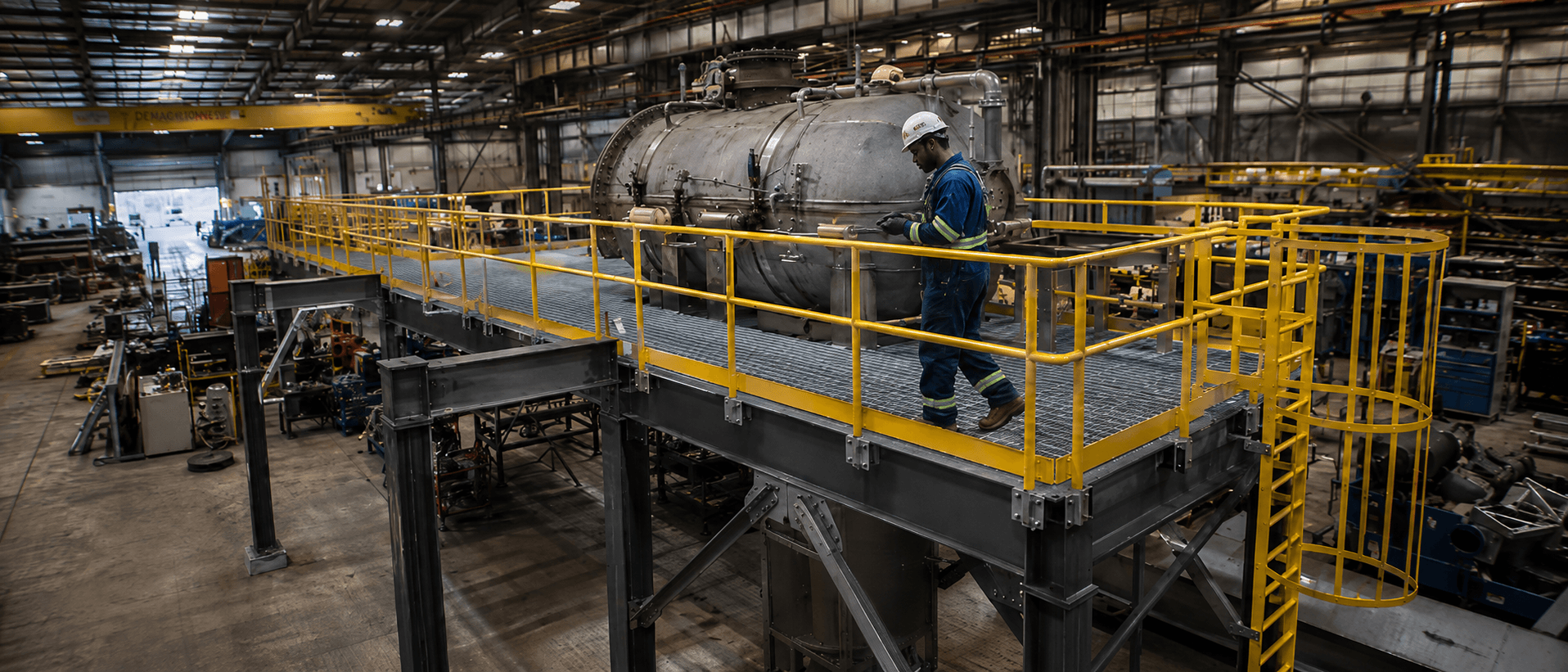
A new tank doesn't arrive on a flatbed and stand itself up. Behind every install there is a foundation, a support frame, a walkway to the manway, and a pipe rack threading the new vessel into your existing utilities. The rest of the steel is usually two to three times the weight of the tank itself. Here is how we approach it.
Pipe racks come first
A pipe rack is the spine of an industrial plant. Get it right and every future addition has somewhere to land; get it wrong and every future utility goes overhead on its own bespoke support. We design pipe racks per Eurocode 3 with realistic future-capacity allowances, typically 30 to 50 percent headroom on the original utility count.
On heat: insulated lines carry surface temperatures the rest of the rack does not. We hold dissimilar utilities apart with spacer rings and we hot-dip galvanise the entire rack so the coating survives the steam-trap drips that always end up falling onto the structural members below.
Tank supports: skirts, saddles, legs
For vertical tanks above 5 m³, a welded skirt is the right answer; below that, three or four leg supports work fine. Horizontal tanks ride on saddles, sized so the contact stress stays within the shell's allowable. Where the tank carries jacketed heating, we leave thermal expansion clearance at one end of the saddle so the shell can grow without dragging the support frame.
The trick most fabricators miss: tank supports need a dye-penetrant inspection on every gusset weld. The shell weld gets inspected because everyone remembers it; the support gusset gets inspected because we have a checklist that does not.
Walkways and access
Every tank above 3 m in height gets a walkway around the top for sample ports, manways, and instrumentation maintenance. Standard: galvanised grating decking with toe-board and handrail per OSHA-style geometry, ladder access with caged fall protection above 6 m, and a rest platform every 6 m of vertical climb.
We design walkways with the operator's actual workflow in mind. The most common mistake is to drop the access ladder on the far side of the tank from the instrument panel, which means the operator carries his tools around the platform every time. Place the ladder where the work is.
Where structural sits in our scope
Most of our customers buy structural alongside the tank or silo. A single workshop turnaround is faster, the structural steel arrives with the right coating already on it, and the tank-to-support interface fit is checked in the workshop, not on the install site. The structural fabrication page carries the full scope; see the local manufacturing page for the workshop process behind it.
Choosing a flow meter for a Kenyan industrial loop
Electromagnetic, vortex, ultrasonic, Coriolis, or thermal-mass? The medium, the pipe size, and the accuracy you actually need decide which one belongs on the line.
Read26 May 2026How to specify a stainless tank for a Kenyan F&B plant
Material grade, surface finish, sanitary fittings, and the questions your fabricator wishes you'd ask first.
Read22 May 2026Reading the Kenyan discharge parameters table, for plants that need to pass
The 10 parameters that decide whether your effluent enters a public sewer or an environmental discharge route, what each one means, and what equipment hits each target.
Read