
How to specify a stainless tank for a Kenyan F&B plant
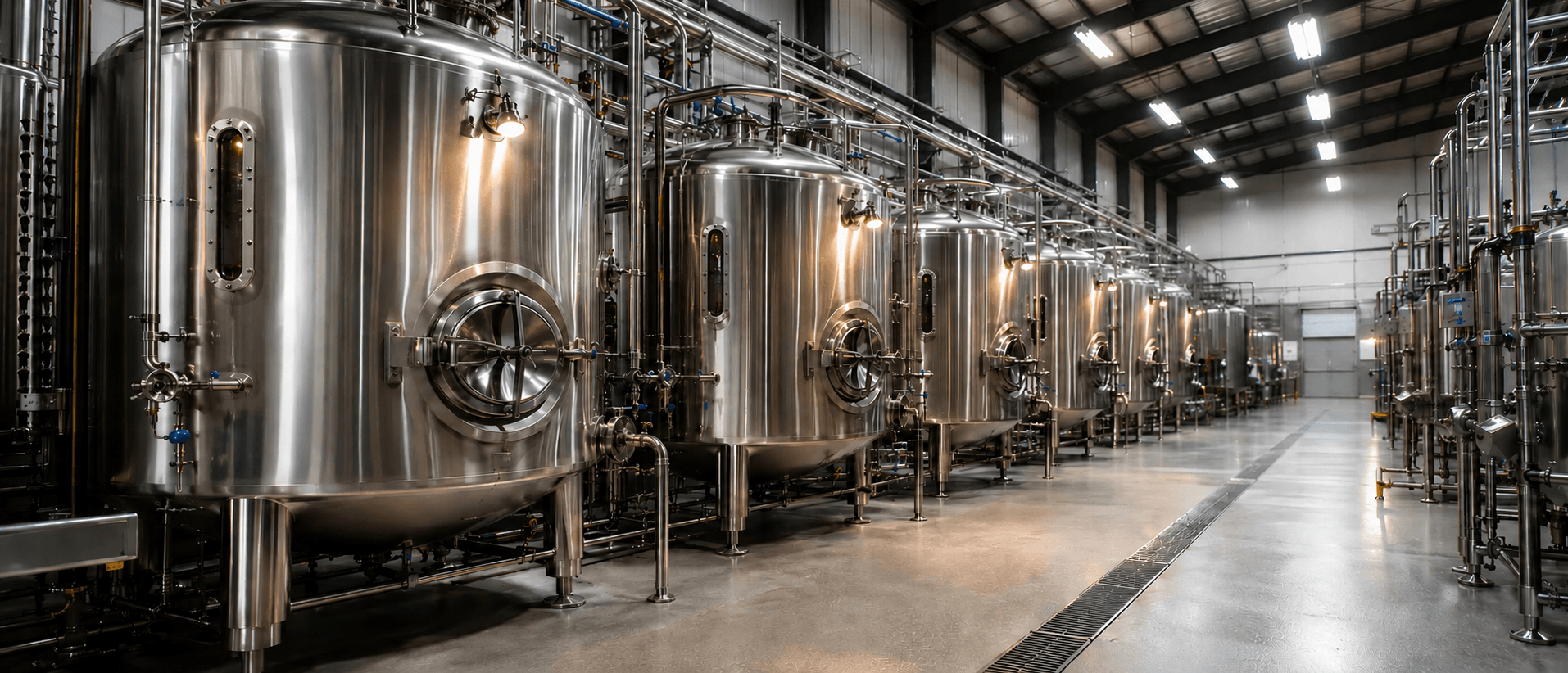
A stainless tank looks like a simple purchase. It is anything but. The same outer cylinder, in two different specifications, can carry a five-times price gap, a four-times difference in service life, and the difference between passing and failing a regulatory compliance audit. Here is what we cover with most F&B buyers, in the order we cover it.
Material grade comes first
304 is the default for most dairy, beverage, and edible-oil duty. It handles chlorides up to roughly 200 ppm without pitting, and it is the right answer for somewhere between seventy and eighty percent of the F&B tanks we ship.
316L is the upgrade when chlorides exceed that threshold. The most common triggers are whey concentrates (high chloride), acid CIP loops (caustic-then-acid wash chemistry), and any process that crosses into pharmaceutical-adjacent duty. The low-carbon variant resists weld-zone sensitisation during repeated CIP cycles, which is why the L grade matters and not just 316 generically.
Surface finish second
Surface finish is specified as Ra (roughness average) in microns. For food contact, target Ra ≤ 0.8 μm; for pharmaceutical-adjacent duty, target Ra ≤ 0.4 μm. A rougher finish gives bacteria more places to hide and makes CIP cycles less effective; a finer finish costs more and rarely matters outside pharma-adjacent processes.
Fittings, last but not least
Sanitary tri-clamp throughout. Tri-clamp fittings can be cleaned, inspected, and replaced without cutting the line, and they leave no crevices for bacteria to colonise. NPT and BSP threads are not appropriate for food contact and should not appear in your spec.
Standard fittings on a food-grade tank: tri-clamp manway, sanitary drain, CIP spray ball, sight glass, temperature port, and pre-tapped instrument ports for level and pH. We ship all tanks pre-tapped for these even when the customer plans to add instruments later; the cost is low and the retrofit cost is high.
What we need from you to spec it
Tell us the medium, the volume, the cycle frequency, the CIP chemistry, and the lead-time pressure. Almost every other decision falls out of those five answers. Want a starting point on the stainless side? The stainless tanks page carries the standard spec sheet; we customise from there.
Choosing a flow meter for a Kenyan industrial loop
Electromagnetic, vortex, ultrasonic, Coriolis, or thermal-mass? The medium, the pipe size, and the accuracy you actually need decide which one belongs on the line.
Read26 May 2026In-house structural fabrication: pipe racks, tank supports, walkways
Tanks and silos don't stand alone. The platforms, racks, and supports around them are usually the load-bearing schedule risk. Here is how we approach the rest of the steel.
Read22 May 2026Reading the Kenyan discharge parameters table, for plants that need to pass
The 10 parameters that decide whether your effluent enters a public sewer or an environmental discharge route, what each one means, and what equipment hits each target.
Read