
NB-IoT for industrial tank monitoring in Kenya
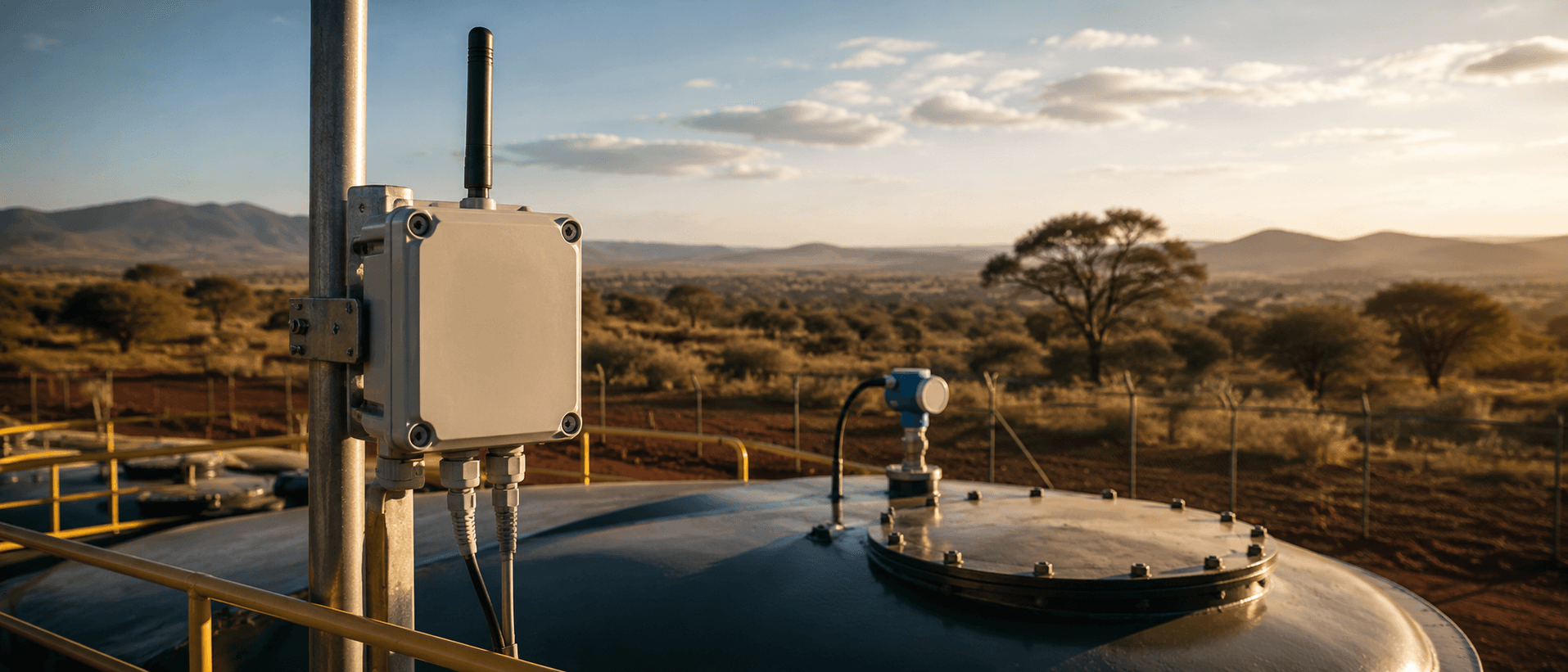
We recommend NB-IoT as the default connectivity option for single-tank monitoring sites in Kenya. Here is what drives that choice.
What NB-IoT actually is
Narrowband-IoT (NB-IoT) is a cellular protocol designed for low-bandwidth, low-power, deep-coverage devices. The data rate is small (a few kilobits per second), the message overhead is small, and the radio is optimised for battery operation. A well-designed NB-IoT sensor can run for three to five years on a primary lithium battery while reporting a tank level every fifteen minutes.
Why Kenya specifically
Kenyan carriers rolled out NB-IoT coverage across most of the country between 2020 and 2023. The base-station coverage reaches sites where 4G LTE signal is patchy or non-existent. For a tank installed at an off-grid water-treatment site, NB-IoT is often the only viable cellular option.
How it shows up on a tank
Physically: a small gateway box mounted near the tank, with one or two cables descending to the level transmitter, the flow meter, or whichever instrument the site is monitoring. Power comes from either a primary battery (multi-year life) or a small solar panel.
Data: the gateway packages each reading into a small message and sends it over the NB-IoT network to a cloud ingestion endpoint. We host that endpoint and run the monitoring app, or we push the data into your existing SCADA system, depending on what suits your IT setup.
When we do not recommend NB-IoT
Two cases: a multi-tank plant where on-prem LoRaWAN gives you a single gateway covering twenty instruments at lower operating cost, and a high-bandwidth site where you need real-time streaming for SCADA integration (4G LTE is better there). Most of our installs are single-tank or low-bandwidth, which is why NB-IoT is the default recommendation.
Full IoT page is at /products/iot/.
Choosing a flow meter for a Kenyan industrial loop
Electromagnetic, vortex, ultrasonic, Coriolis, or thermal-mass? The medium, the pipe size, and the accuracy you actually need decide which one belongs on the line.
Read26 May 2026In-house structural fabrication: pipe racks, tank supports, walkways
Tanks and silos don't stand alone. The platforms, racks, and supports around them are usually the load-bearing schedule risk. Here is how we approach the rest of the steel.
Read26 May 2026How to specify a stainless tank for a Kenyan F&B plant
Material grade, surface finish, sanitary fittings, and the questions your fabricator wishes you'd ask first.
Read